Abstract:
Simulating non-linear thermo-poroelasticity problems, which involve the strong coupling of solid, fluid and thermal phenomena, requires multiphysics solvers. However, classical approaches such as the monolithic and staggered methods often result in numerical issues that can lead to high computation times (resolution of large linear systems, need for iterations, impossibility to deal with various time discretizations …). Therefore, it is relevant to have recourse to model order reduction techniques, especially for problems with high number of degrees of freedom.
The LATIN-PGD solver offers an alternative approach for solving thermo-poroelasticity problems. It natively includes an on-the-fly model order reduction technique: the Proper Generalised Decomposition (PGD). This approach has been proven to be both suitable and competitive with respect to classical multiphysics approaches. Furthermore, it features high modularity, enabling models of different fidelity levels to be coupled.
Short bio:
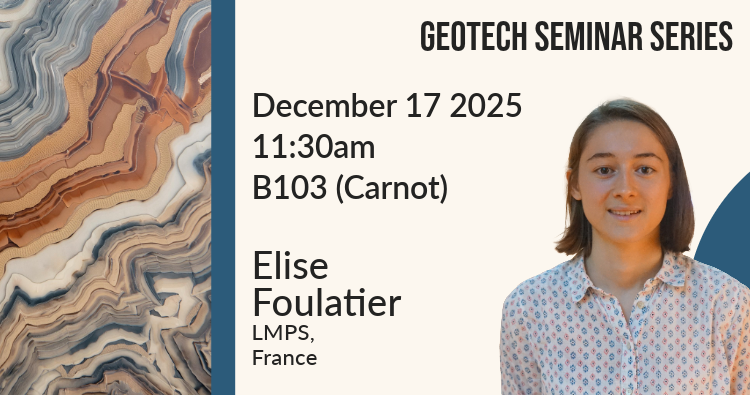
I am a 2nd year Ph.D. student in computational mechanics at Laboratoire de Mécanique Paris-Saclay (a joint research unit between Université Paris-Saclay, CentraleSupélec, ENS Paris-Saclay, and CNRS). Before starting my doctoral studies, I graduated from ENS Paris-Saclay, where I passed the agrégation in mechanics and completed a master degree in computational mechanics at Université Paris-Saclay. My research focuses on the simulation of multiphysics problems, with a deep interest in model order reduction and hybrid coupling between physical models and multi-fidelity data.