


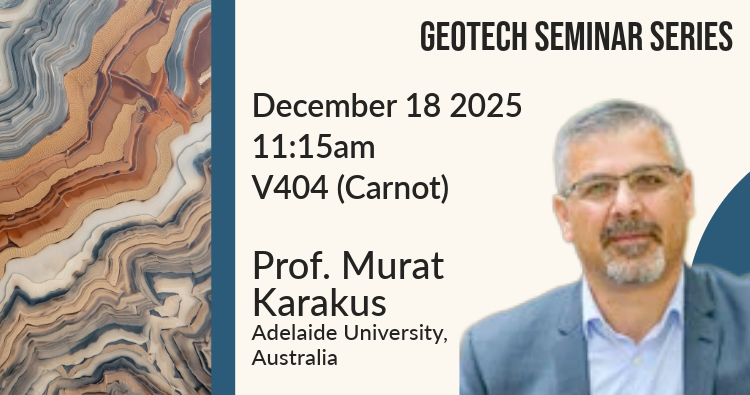
Séminaire Geotech : Prof. Murat Karakus (Adelaide University, Australia)
From Damage to Banding: Modelling the True Mechanics of Rock Caving
Abstract:
This work introduces the first continuum-based numerical framework that reproduces the full caving process and the two key failure mechanisms debated in cave mining: continuous damage and discrete parallel fracture banding. Using SPH with an advanced damage–plasticity model, the simulations successfully capture experimentally observed banding and show that it arises from consistent undercutting and a shift from compression-shear to tensile-shear failure. The results highlight the decisive role of dilation angle, e.g. high dilation stabilises arching, while low dilation drives progressive banded failure, and reveal strong sensitivity to tensile fracture energy, material heterogeneity, and horizontal stress. Close agreement with centrifuge tests confirms the framework as a powerful tool for understanding rock cavability.
Short bio:
Prof. Murat Karakus holds a BSc in Mining Engineering (Hacettepe University) and a PhD in Mining and Minerals Engineering (University of Leeds). He is an Adjunct Chair Professor at the China University of Geosciences and a senior academic at the University of Adelaide, where he founded the Cave Mining Research Centre.
His research focuses on rock mass behaviour in deep and extreme mining environments, including cave propagation, rockburst prediction, mud-inrush mechanisms, thermo-mechanical degradation, and advanced rock support design. He develops continuum and particle-based numerical models, large-scale experimental methods, and data-driven approaches to understand failure processes. His recent work integrates machine learning, digital twins, and smart sensing to improve safety and productivity in deep mining operations.
Prof. Karakus is Chief Investigator on more than $12 million in competitive and industry-funded projects, and he was named Australia’s top national researcher in Mining and Mineral Resources in 2023.
He leads a multidisciplinary team of over 20 researchers and students and collaborates broadly across mining, petroleum, mechanical, chemical, civil engineering, and the Australian Institute of Machine Learning. With more than 200 peer-reviewed publications, he is internationally recognised. He serves on major ISRM committees, and he is the associate editor of Rock Mechanics and Rock Engineering and the International Journal of Rock Mechanics and Mining Sciences.