

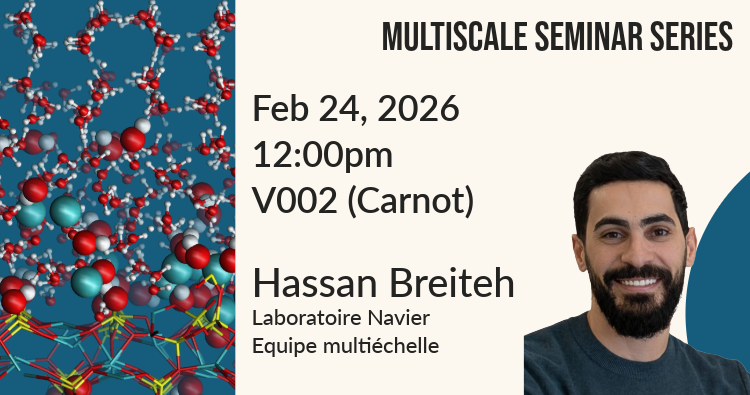
Séminaire Multiéchelle : Hassan Breiteh (Navier – Multiéchelle)
Mechanics of swelling clay faults: from molecular simulations to earthquakes
Abstract:
Swelling clays, and in particular Na-montmorillonite, play a key role in the mechanical behavior of fault zones and other geological systems. Their hydration state, controlled by temperature, pressure, and water chemical potential, strongly affects their swelling, stability, and frictional properties. Understanding these mechanisms is essential to bridge the gap between nanoscale processes and large-scale fault dynamics.
In this seminar, I will present a multiscale approach based on molecular dynamics simulations to investigate the hydration and swelling behavior of Na-montmorillonite under realistic thermo-hydro-mechanical conditions. By imposing relative humidity instead of a fixed number of water molecules, we derive a complete hydration phase diagram identifying stable, metastable, and unstable hydration states. Thermodynamic analysis based on swelling free energy minimization allows us to capture phase transitions under both undersaturated and supersaturated conditions.
I will then introduce a refined analytical model that reproduces the molecular simulation results and regenerates hydration phase transitions efficiently. This model provides a robust framework to explore pressure-temperature paths beyond direct simulations. Finally, perspectives toward shearing simulations are discussed, with the objective of linking hydration state to elasticity, strength, and rheology, ultimately contributing to a better understanding of fault mechanics and earthquake processes.
Short bio:
I am a Ph.D. student in geomechanics at Laboratoire Navier (École nationale des ponts et chaussées, Université Gustave Eiffel, CNRS), working within the SMEC project. I hold a Master’s degree in Reservoir Engineering from ENSG (Université de Lorraine) and a Bachelor’s degree in Petroleum Engineering from Shiraz University. My research focuses on molecular and analytical modeling of swelling clays, with an emphasis on hydration thermodynamics, phase transitions, and their mechanical implications. I combine molecular dynamics simulations, thermodynamic modeling, and analytical approaches to bridge nanoscale processes with macroscopic fault behavior and geophysical applications.