

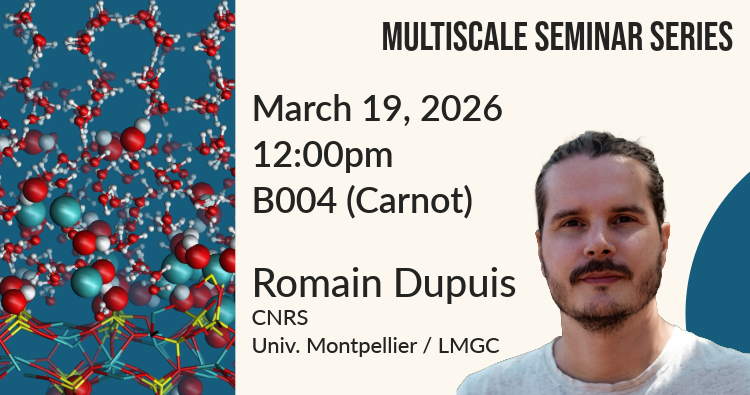
Séminaire Multiéchelle : Romain Dupuis (CNRS, Univ. Montpellier / LMGC)
Multiscale modeling of reactive porous systems
Abstract:
What can molecules teach us about concrete, geopolymers, or supercapacitors? Behind these everyday materials lie complex phenomena that occur at molecular interfaces and are often difficult to access experimentally. Atomistic simulations provide a powerful framework to unravel these mechanisms that we now use for investigating construction, energy and depollution materials.
We can take concrete as a representative example: certain gels and mineral phases form within cement pores after hardening and may crack the material. Under which conditions do these phases develop, and how do they generate internal stresses within the cement matrix? Using molecular simulations, we found that gel formation induces ion concentration between interfaces, which may explain the formation of cracks in concrete observed experimentally. Beyond concrete, similar questions arise in energy storage and water treatment, where the structure and deformation of porous materials play a central role. A major research challenge is therefore the development of multiscale approaches that validate models and bridge microscopically mechanisms with macroscopic properties. In our work, chemical reactions are key drivers of material aging and thus of long-term durability.
In this seminar, I will present several methodologies we are developing to incorporate chemical reactivity from the molecular scale up to the mesoscopic scale. I will illustrate these approaches through key applications, highlighting their potential for both fundamental and more applied research. These examples will show how multiscale reactive modeling can contribute to the design of solutions for energy technologies (storage, desalination) and to a deeper understanding of water decontamination processes, including eternal pollutants.
Short bio:
Romain Dupuis est chargé de recherche CNRS depuis 2022 au Laboratoire de Mécanique et de Génie Civil (LMGC) à Montpellier, au sein de la section CNRS Ingénierie. Après son doctorat à l’université Toulouse Paul Sabatier, il a effectué plusieurs post-doctorats, en Espagne et aux États-Unis, notamment au MIT, sur les matériaux cimentaires, les géopolymères et les matériaux poreux. Ses travaux portent sur la modélisation atomistique et multi-échelles de matériaux complexes, à l’interface entre chimie, physique et mécanique. Il développe et utilise des approches numériques avancées (dynamique moléculaire réactive, métadynamique, champs de force issus du machine learning, modèles coarse-grained) pour étudier la structure, la réactivité, le transport ionique et la durabilité des matériaux poreux. Ses recherches s’appliquent principalement aux matériaux cimentaires et géopolymères, aux systèmes capacitifs pour le stockage de l’énergie et le dessalement, ainsi qu’aux matériaux dédiés à la dépollution de l’eau et à la récupération de ressources critiques (PFAS, lithium, hydrogène). Il est porteur ou co-porteur de plusieurs projets et encadre doctorants et post-doctorants dans un contexte fortement interdisciplinaire.