Séminaire RMP: Dr. Adilson Samba (RMP, Navier)
Osmotic Compression–Driven Zeolite Formation: In Situ Monitoring of Gel-to-Crystal Transition by ¹H NMR Relaxometry.
Abstract:
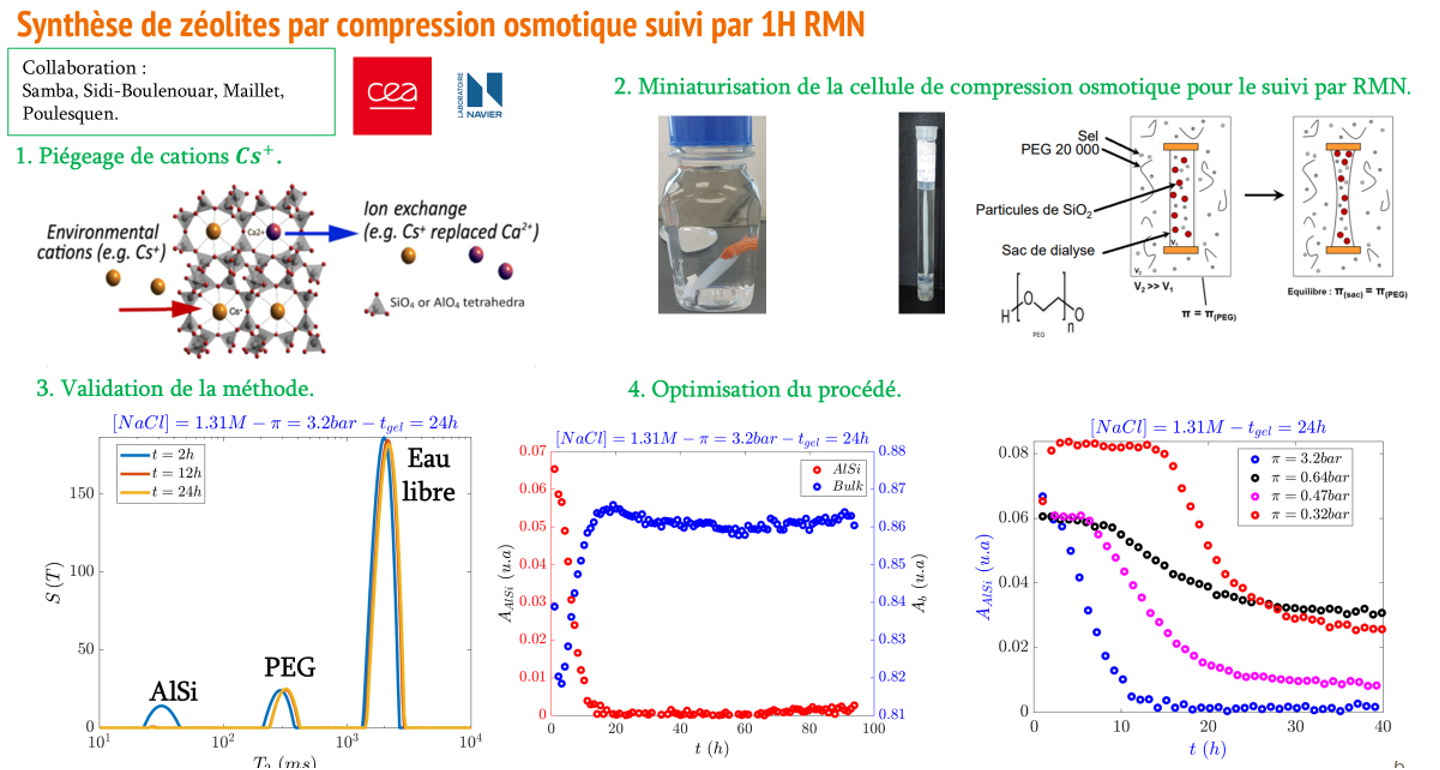
Zeolites are crystalline aluminosilicates with high porosity and tunable surface properties, widely used as catalysts, adsorbents, and ion exchangers. Their conventional hydrothermal synthesis, however, is energy-intensive and poorly suited for real-time monitoring of the gel-to-crystal transition. In this work, we introduce an alternative, low-energy approach for zeolite synthesis based on osmotic compression of aluminosilicate gels. By applying a controlled osmotic pressure gradient using polyethylene glycol (PEG) solutions across a semi-permeable membrane, water is extracted from the gel, inducing densification and subsequent crystallization at room temperature.
To probe the kinetics of water transport and gel-to-crystal transformation, we developed a non-invasive in situ monitoring strategy using ¹H NMR relaxometry. A custom-designed, 3D-printed miniaturized osmotic cell compatible with NMR measurements enables the real-time acquisition of T₂ relaxation distributions. These distributions provide quantitative information on water populations (free vs. bound) and their evolution during osmotic stress.
Our results reveal a clear correlation between gel shrinkage, T₂ decay, and zeolite formation, confirming that proton NMR relaxation is a sensitive probe of structural evolution during osmotic compression. In addition, the water transfer measured by 1H NMR was successfully predicted by a diffusion-type model based on the aluminosilicate particle volume fraction. This methodology establishes a novel, energy-efficient, and physically insightful route for zeolite synthesis and opens prospects for monitoring and controlling phase transitions in colloidal or gel-based materials under osmotic confinement.