

Water diffusion in wood and plant cell walls: An activated process
- Post by: florence.rouyer
- 14 janvier 2026
- No Comment
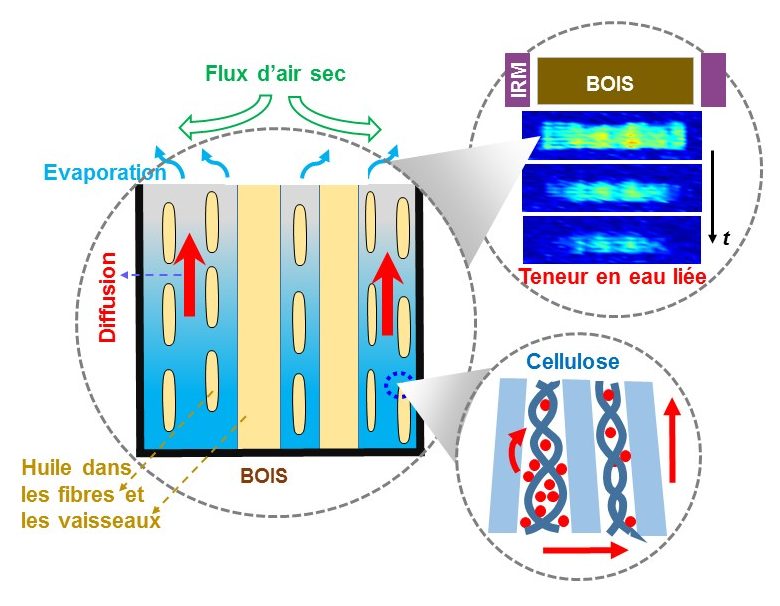
Wood, plants, and cellulosic materials contain significant amounts of bound water, up to 30% of their dry mass, present as nanoscale inclusions of water molecules within a solid matrix. This bound water is mobile and exchanges readily with vapor and free water; however, its transport dynamics remain poorly understood due to the lack of direct observations. In this study, nuclear magnetic resonance and magnetic resonance imaging were used to characterize bound water diffusion in various wood types and cellulose fibers across different directions and at different temperatures. To isolate bound water dynamics, the accessible pores were filled with oil, and bound water distribution was tracked during desorption. The results demonstrated that bound water diffusivity is independent of both its concentration and its direction, despite the pronounced anisotropy of wood, and exhibits an exponential dependence on the inverse of the temperature. These observations suggest that bound water transport is an activated process, analogous to the diffusion in solids, with an activation energy comparable to the latent heat of liquid water evaporation. These findings show that bound water enables efficient long-distance moisture transport through wood and plant structures, irrespective of whether the voids are closed, empty, or filled with nonaqueous liquid, provided a local bound water deficit exists. Consequently, bound water spontaneously refeeds a desaturated plant system. This phenomenon plays a fundamental role in water extraction, water imbibition, and moisture transport in living plants and cellulosic materials.
https://journals.aps.org/prapplied/abstract/10.1103/5qm8-trjr