

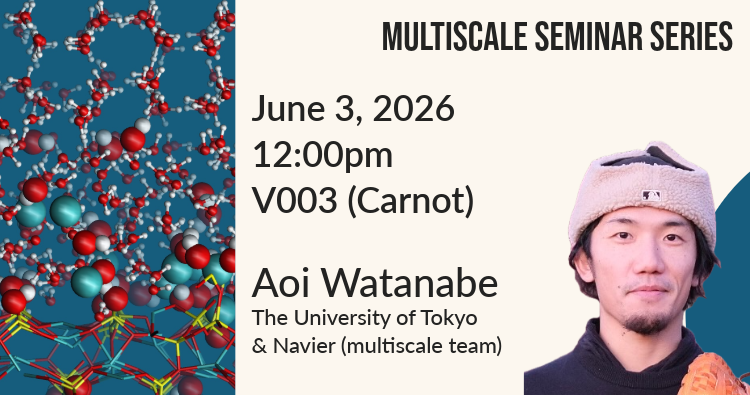
Multiscale seminar : Aoi Watanabe (The University of Tokyo & Navier/multiscale)
Beyond Spatial Scaling Limits: Time-Parallel Molecular Dynamics using Parareal
Abstract:
Machine Learning Potentials (MLPs) capture complex atomic interactions with DFT-level accuracy, but their computational cost remains several orders of magnitude higher than classical empirical models like the Embedded Atom Method (EAM). Although traditional spatial parallelization reduces calculation costs, its efficiency is limited by communication overhead. When the workload per core falls below approximately 100 atoms, performance degrades significantly. While spatial decomposition is well-established, parallelizing inherently sequential time-evolution simulations in the temporal direction remains a significant challenge. To overcome these limitations, we propose a space-time parallelization strategy using a hybrid Parareal framework. The Parareal algorithm decomposes the total simulation time into multiple temporal blocks. It utilizes a fast “Coarse Solver" (EAM) to generate an initial trajectory guess, which is iteratively corrected by a high-accuracy “Fine Solver" (MLP) running simultaneously across parallel processors. To maximize efficiency, we introduce a dynamic window-shifting strategy. Instead of iterating over a fixed time span, our approach identifies where the coarse trajectory deviates from the fine one and focuses computational resources on a targeted temporal window. Once the early blocks within this window converge, the active computational domain shifts forward, preventing wasted computation on divergent paths.
In this seminar, we introduce our framework and present its benchmark performance on a tungsten system, where the MLP is approximately 61.9 times slower than the EAM when estimated on a block (short run). We demonstrate that combining these two potentials with the window-shifting strategy achieves a benchmark score 2.7 times faster than the maximum speedup attainable through pure spatial decomposition. By combining spatial and temporal parallelism in an orthogonal manner, the framework achieves continued acceleration beyond the saturation point of spatial scaling alone, providing substantial practical benefits for large-scale material analysis.
Short bio:
Aoi Watanabe is a 2nd year Ph.D. student in the Department of Materials Engineering at the University of Tokyo, where he also received his B.S. and M.S. degrees under the supervision of Professor Yasushi Shibuta. He is currently a visiting student for seven months at the Navier Laboratory, ENPC, working with Professor Laurent Brochard. His primary research interests lie in molecular dynamics, data assimilation, and high-performance computing. In addition to his academic pursuits, he is a Co-Founder of HarvestX, a tech startup dedicated to automated strawberry cultivation, where he led both software and hardware engineering.