


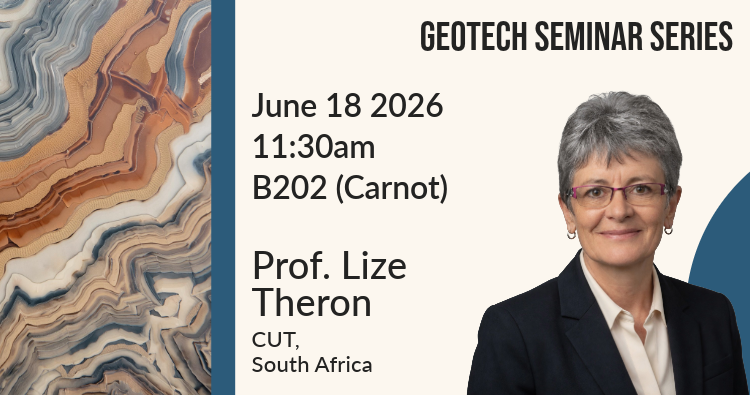
Séminaire Geotech : Prof. Lize Theron (CUT, Afrique du Sud)
Expansive Clay Characterisation in South Africa: Test Reliability, Spatial Variability, and the Case for a New Stabilisation Approach
Abstract:
Expansive clay soils derived from Karoo Supergroup mudstones and shales dominate the subgrade geology of the Free State and North West provinces of South Africa. Mineralogically controlled by smectite minerals — predominantly montmorillonite — these soils exhibit plasticity indices that commonly exceed 25, extreme seasonal suction fluctuations ranging from less than 10 kPa to well above 100 000 kPa, and swell pressures sufficient to cause repeated, catastrophic road infrastructure failure within 3–5 years of construction. A central research finding concerns the unreliability of standard geotechnical test methods when applied to these soils. Work conducted with Stott demonstrated that widely used procedures, including the hydrometer test and the conventional Soil Water Characteristic Curve, contain fundamental shortcomings that systematically produce erroneous or misleading results in South African practice, including artefacts introduced by the log-linear representation that have misled theoretical modelling for decades. A second critical finding is the role of spatial variability. Research showed that the intrinsic variability of suction potential and shrink-swell characteristics in apparently uniform profiles can be so large that a single test result has little predictive value. Differential heave driven by this variability, not high average heave, is frequently the true cause of structural damage, and a 60% probability exists of underestimating expansiveness from a single sample at a severely damaged site. Subsequent work with Fondjo and Ray developed semi-empirical predictive models that link swelling stress, suction, air-entry values, and unsaturated shear strength to standard index properties, advancing reliable subgrade design in data-limited African engineering environments. The seminar concludes by framing the engineering case for bio-based stabilisation: what the data tells us about why conventional approaches have fallen short, and what performance criteria any next-generation solution must meet.
Short bio:
Prof. Elizabeth (Lize) Theron is a Professor of Geotechnical Engineering at the Central University of Technology (CUT), Bloemfontein, South Africa, where she leads the CiviLab@CUT research group. She holds a PhD (University of the Free State) and an MTech in Civil Engineering, and is registered as a Professional Engineering Technologist (Pr. Tech. Eng.) with ECSA, on whose Council she serves as a member. With 35 years of research experience, she is nationally recognised for her work on the identification, characterisation, and unsaturated behaviour of South African expansive clays. She is a three-time recipient of the J.E. Jennings Award (SAICE, 2017–2019) and has managed several research projects, including grants from the Royal Academy of Engineering (UK) and the NRF. She currently leads a multi-national bio-based road rehabilitation research programme spanning South Africa, Ethiopia, Japan, and Europe.