


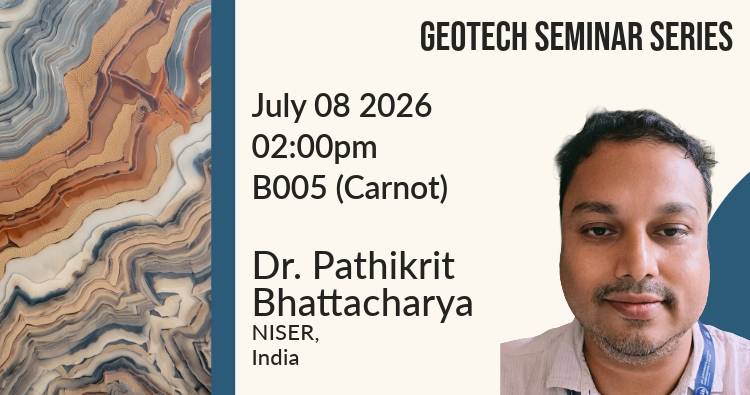
Séminaire Geotech: Dr. Pathikrit Bhattacharya (NISER, India)
Frictional sliding under variable normal stress reveals characteristic differences in contact 'quality' across frictional interfaces
Abstract:
The rate-and-state friction equations are the most widely used framework for describing frictional evolution in rocks and earthquake models. Despite their success, the physical meaning of the evolving frictional “state" remains poorly understood. Frictional resistance is commonly attributed to the shear strength of contacting asperities, and state evolution is generally assumed to reflect changes in the real contact area under low-temperature plasticity. An alternative possibility is that state evolves primarily through changes in the area-averaged strength of these contacts often called contact ‘quality’.
Using normal stress step experiments spanning 5% to nearly 100% increases in normal stress, we show that the transient evolution of friction following medium-to-large stress steps cannot be explained by changes in real contact area alone. Instead, changes in area-averaged contact strength dominate the response. We develop a framework of evolution equations for contact area, area-averaged contact quality, and state that incorporates the quality contrast between old and newly formed contacts as a rate-and-state parameter. We show that the transient slip-rate reduction following a normal stress step provides a robust measure of this quality contrast across all step sizes. The laboratory data seem consistent with newly formed contacts that are only 10–20% as strong as the preexisting contacts and strengthen progressively with slip until the original steady-state strength is recovered. These results suggest that frictional state evolution reflects changes in contact quality as well as contact area, providing a framework for replacing empirical state evolution laws with constitutive descriptions rooted in the underlying microphysical processes.
Short bio:
I am a geophysicist working as a faculty at the School of Earth and Planetary Sciences at the National Institute of Science Education and Research, India. I work at the interface of earthquake physics, fault mechanics, and crustal deformation. I combine laboratory friction experiments, seismic observations, and physical modeling to investigate the processes governing earthquake nucleation, fault slip, and earthquake swarms. I did my M. Tech. in Applied Geophysics at IIT Roorkee followed by an M. S. in Geophysics at the University of Western Ontario, PhD from Princeton University and postdoctoral research at Tufts University.