
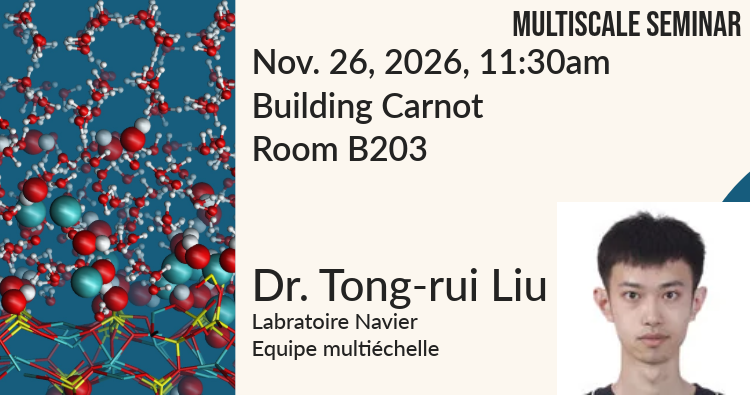
Séminaire Multiéchell : Tong-Rui Liu (Navier)
Accelerating Computational Micromechanics: From Physics-Based Model order Reduction to Operator Learning
Abstract:
Accurate and efficient prediction of the mechanical responses of heterogeneous materials remains a fundamental challenge in computational mechanics, particularly when complex microstructures and multiscale interactions must be resolved. While conventional full-field numerical methods provide high-fidelity solutions, their computational cost often limits their applicability to large-scale simulations and material design. In this talk, two complementary approaches to accelerating computational micromechanics will be presented, combining physics-based reduced-order modeling and data-driven operator learning within the framework of the Lippmann–Schwinger equation.
In the first part, I will introduce a “uniform polarization-driven self-consistent clustering analysis (UP-SCA)"" framework for efficient computational homogenization. By replacing the computationally expensive offline simulations required in conventional SCA with a polarization-driven clustering procedure, the proposed method significantly simplifies the offline stage. More importantly, the resulting clustering patterns depend primarily on the microstructural geometry rather than the elastic properties of individual material phases, enabling their reuse across different material configurations. The accuracy and generality of this approach are demonstrated through a variety of complex three-dimensional microstructures.
In the second part, I will present “Micrometer", a neural operator for predicting full-field mechanical responses of heterogeneous materials. By learning the mapping from spatially varying elastic properties to local strain concentration tensors, Micrometer enables efficient predictions under arbitrary macroscopic loading conditions in linear elasticity. Trained on a large-scale dataset of fiber-reinforced composites, the model achieves high predictive accuracy with substantial computational speedups. Its applications to computational homogenization, concurrent multiscale modeling, and transfer learning to unseen microstructures will also be discussed.
Together, these studies illustrate two complementary directions for advancing computational micromechanics: “physics-based model reduction that preserves the underlying mechanical structure, and data-driven operator learning that enables rapid full-field predictions". Their respective strengths and challenges provide insights into developing more efficient and generalizable computational frameworks for multiscale modeling of heterogeneous materials.
Short bio:
Tong-Rui Liu is a postdoctoral researcher at CNRS Laboratory Navier, Institut Polytechnique de Paris. He received his PhD in Computational Mechanics from Imperial College London. His research interests include computational solid mechanics, high-performance scientific computing, multiscale modeling, and artificial intelligence for partial differential equations (AI4PDE). His current project focuses on developing reduced order modeling for computational homogenization of heterogeneous materials.