

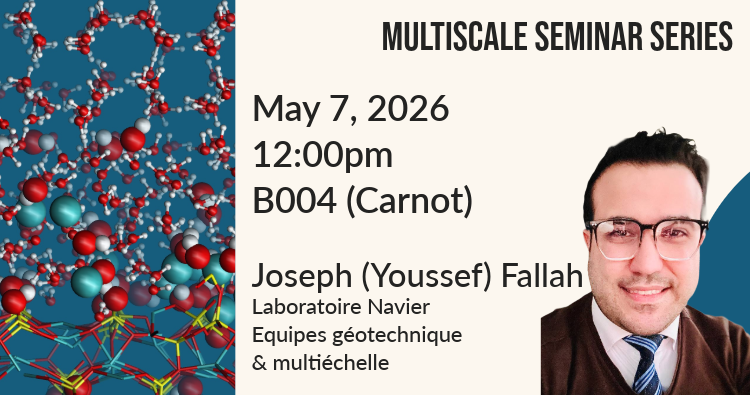
Séminaire Multiéchelle : Joseph (Youssef) Fallah (Navier – Géotechnique & Multiéchelle)
Evaluation of the risk of over-damage in Callovo-Oxfordian claystone under the coupled effects of bituminized waste swelling and gas pressurization
Abstract:
For French intermediate-level long-lived bituminized waste products, the reference management option is deep geological disposal in the Cigéo facility, within the Callovo-Oxfordian claystone. After approximately one to several hundred thousand years, water from the host rock may saturate the disposal cells and come into contact with the bituminized waste products, thereby inducing swelling. Due to the semi-permeable behavior of the bituminous matrix, which allows water transfer while limiting salt transport, water uptake can generate osmotic swelling. Once the available voids around the waste packages are filled, this swelling may occur under confined conditions and exert mechanical loading on the surrounding host rock. In parallel, gas production, mainly associated with metallic corrosion and water radiolysis, may lead to progressive gas pressurization around the disposal galleries. The combined action of bituminized waste swelling and gas pressurization therefore raises the question of potential fracture initiation and propagation around the tunnels.
This work investigates the long-term hydromechanical response of unsaturated Callovo-Oxfordian claystone subjected to these coupled mechanisms. The modelling framework builds on a previously developed two-phase gas-liquid flow model for unsaturated Callovo-Oxfordian claystone and fractures, in which fluid transfers are represented both in the porous matrix and in the fracture network. In the present work, this framework is extended to account for the swelling of bituminized waste products, the associated water uptake, and their coupled mechanical interaction with gas pressurization and fracture propagation around the disposal gallery. The swelling process is represented by a time-dependent law calibrated against experimental data, while the associated water uptake is introduced through a time-dependent hydraulic flux at the bituminized waste-rock interface, ensuring consistency between swelling deformation and water transfer. Gas-liquid transfers, capillary pressure effects on effective stress, poromechanical coupling and cohesive fracture propagation are simulated within the finite element code Disroc. The numerical implementation is assessed by comparison with FEniCS simulations and semi-analytical solutions for cracks emanating from a pressurized cylindrical cavity. The simulations compare complete and simplified loading scenarios and analyze the influence of gas pressure, asymptotic free swelling strain, hydraulic flux, poromechanical coupling and pre-existing fractures.
This seminar will present the modelling strategy, its numerical validation, and the main results obtained on the coupled effects of bituminized waste swelling and gas pressurization on fracture propagation around deep disposal galleries.
Short bio:
Joseph (Youssef) Fallah is a postdoctoral researcher at Laboratoire Navier, École des Ponts – IP Paris. His research focuses on the coupled hydromechanical behavior of fractured geomaterials, with particular emphasis on gas pressurization, two-phase flow and fracture propagation around underground excavations. Following two Master’s degrees in geotechnical engineering and georisk engineering in France, he completed his PhD in December 2024 on modelling fracture propagation in porous rocks under gas injection. His work combines fracture mechanics, finite-element modelling and the analysis of unsaturated fracture-matrix systems, building on coupled hydromechanical formulations and cohesive-zone fracture descriptions within the Disroc code.