

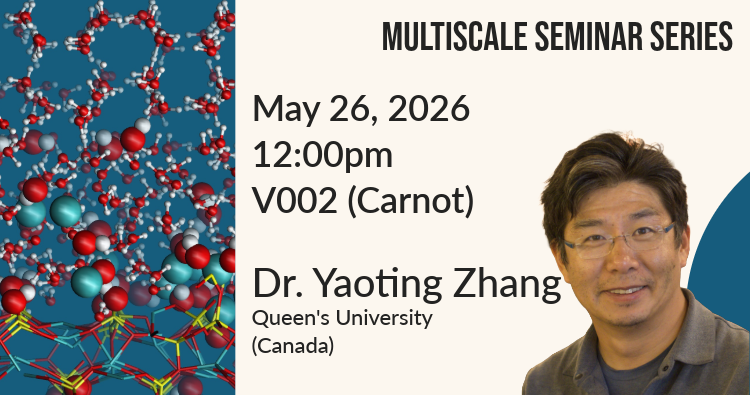
Séminaire Multiéchelle : Dr. Yaoting Zhang (Queen’s University, Canada)
Computational Clay Research at Queen’s University (Canada)
Yaoting Zhang1, Yalda Pedram1, Chang Seok Kim2, Laurent Brochard3 and Laurent K. Beland1
1. Queen’s University Canada,
2. Nuclear Waste Management Organization of Canada
3. ENPC
Abstract:
Montmorillonite (MMT)-based bentonite clays are key engineered barrier materials in deep geological repositories for spent nuclear fuel due to their swelling capacity, low permeability, and diffusion-limiting properties. Understanding how pore structure, interlayer transport, and ion interactions influence long-term transport behavior remains a major challenge because these processes span multiple length and time scales. This presentation introduces a multiscale computational framework developed at Queen’s University to investigate clay transport and mechanical behavior from atomistic to mesoscale scales.
Atomistic molecular dynamics simulations using ClayFF are employed to characterize hydrated montmorillonite interactions and calculate potential of mean force (PMF) profiles for platelet configurations under dry and hydrated conditions. These PMFs are subsequently used to parameterize coarse-grained (CG) mesoscale models capable of simulating significantly larger clay systems while retaining key structural and thermodynamic behaviors. The resulting models reproduce pore-size distributions, compaction behavior, interlayer evolution, and diffusion scaling trends across a range of dry densities relevant to nuclear waste repositories.
The work further explores transport limitations associated with interlayer diffusion, random-walk tortuosity analysis, and the influence of hydration state on effective diffusivity. Recent developments include Gaussian process regression corrections to CG interaction potentials, improves the Na-MMT interlayer behaviour. In parallel, Cu–ClayFF parameterization was developed, and incorporation of Ca2+ ions in as a CG model into the CG framework are currently being developed.
Overall, this multiscale framework provides a computational pathway for linking nanoscale clay physics to continuum-scale transport properties, supporting the long-term assessment of engineered barrier systems for radioactive waste containment.
Short bio:
Yaoting Zhang is a Research Associate, Project Manager, and PhD researcher in computational chemistry at Queen’s University in the Béland Research Group. His research focuses on friction and transport phenomena between surfaces using multiscale modeling approaches that combine atomistic simulations, coarse-grained modeling, and machine learning techniques. His work aims to bridge computational modeling with real-world experimental observations to develop more predictive and practical materials research frameworks for energy and environmental applications.