


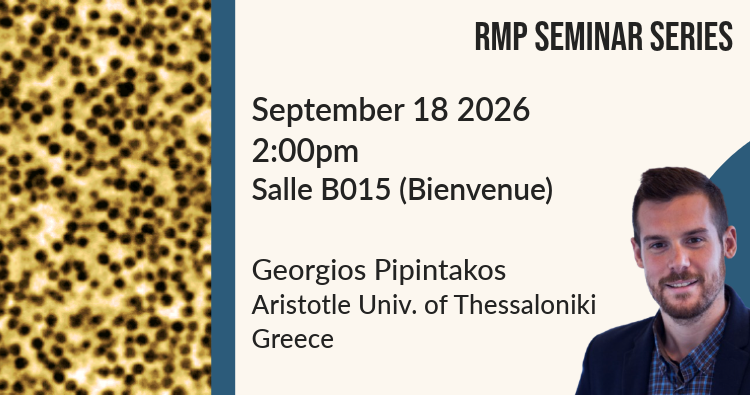
Séminaire RMP: Georgios Pipintakos (Aristotle U. Thessaloniki)
Bitumen Chemomechanics for Durable Asphalt Roads: Where we stand in 2026
Summary:
Asphalt
roads consist of aggregates, filler and bitumen, with the latter functioning as the binding medium. With time, bitumen, as an organic material, loses its superior viscoelastic performance under traffic loading due to exposure to environmental conditions, a phenomenon that is known as ageing. This phenomenon is well documented in the scientific literature with regard to its rheomechanical effects. However, to understand the ‘whys’ behind these alterations, one should additionally seek the chemistry of bitumen.
During the last decade, there has been a significant shift in the research interest to the so-called bitumen chemomechanics. This presentation revisits spectroscopic, thermoanalytical, microscopic and rheological approaches as robust tools to study this interlinkage and shows their full capabilities in bitumen science. Additionally, it highlights the significance of multivariate statistics when interrelationships become more complicated among different research scales. All in all, this presentation provides a deeper scientific insight into the oxidative ageing mechanisms in bitumen and clarifies the relationship between chemical and rheological characteristics, which may contribute as a guideline to a more sustainable road infrastructure in the future.
Since
October 2023, Georgios Pipintakos has been a Research Foundation Flanders (FWO) postdoctoral research fellow within the Sustainable Pavements and Asphalt Research (SuPAR) group of the Faculty of Applied Engineering at the University of Antwerp. His current project examines the oxidative mechanisms of polymer-modified bitumen in combination with polymer deterioration over time, while he is the (co)-PI of several projects related to the chemomechanics of bio-modified binders.
Georgios recently secured the prestigious Marie Skłodowska-Curie Postdoctoral Fellowship 2025 (WIDERA Talents) funded by the European Research Executive Agency, and from October 2026, he will be working at his alma mater, Aristotle University of Thessaloniki in Greece.
In 2022, he was successfully awarded the title of Doctor in Applied Engineering from the University of Antwerp. His PhD project, under the supervision of Prof. Wim Van den bergh (University of Antwerp) and Dr. Hilde Soenen (Nynas), was titled: Towards an enhanced understanding of the oxidative ageing mechanisms in bitumen. He also holds a M.Eng. diploma (2015) in Civil Engineering from Aristotle University of Thessaloniki, Greece and a M.Sc. diploma (2018) in Structural Engineering with specialisation in Roads and Railways from Delft University of Technology, Netherlands.
Recently, Georgios has been nominated as the laureate of the Robert Oppenheimer Award 2025 for his innovations in bitumen chemomechanics. He has authored and oauthored more than 60 publications in highly esteemed international journals, has participated in several international conferences and has been awarded the best podium presentation award at EATA 2025. He is a member of several technical committees for testing and characterisation of bituminous binders (Eurobitume, RILEM, TRB). He is also the European representative of the Global Antioxidant Consortium. Finally, together with 30 early-career researchers around the globe, he has established a community for young PhD researchers called ‘Young Ageing Crew’.