PhD Defense – Siyuan HE
- Post by: sebastien.gervillers
- 5 December 2025
- No Comment
Siyuan He a PhD candidate in the Architectured Materials and Structures team will defend his dissertation titled « Surface fitting via quasi-periodic architectured inflatables » on Friday, december 12 at 10:00am in the amphitheater at Bienvenüe (Université Gustave Eiffel).
Composition du jury :
• Mme. Maud MARCHAL, Professor, Univ. Rennes, INSA/IRISA, ENSAPL (Reviewer)
• M. Sébastien BRISARD, Professor, Univ. Aix-Marseille (Reviewer)
• Mme. Florence BERTAILS-DESCOUBES, Research Director, Inria Grenoble Rhône-Alpes (Examinator)
• M. José BICO, Professor, PMMH-ESPCI-PSL(Examinator)
• M. Jonàs MARTíNEZ, Researcher, Centre Inria de l’Université de Lorraine (Examinator)
• M. Arthur LEBÉE, Professor, École nationale des ponts et chaussées (Thesis Director)
• Mme. Mélina SKOURAS, Researcher, Inria Grenoble Rhône-Alpes(Thesis Supervisor)
The defense will be broadcast live
Abstract
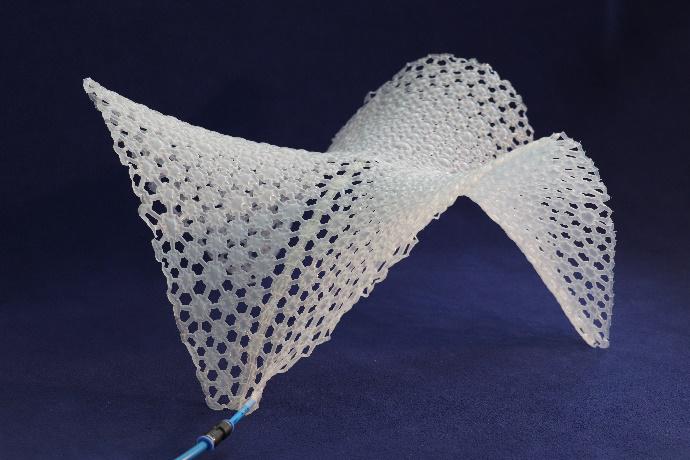
We perform nonlinear homogenization in the finite transformation regime of architectured inflatables made of two superimposed quasi-inextensible membranes. Such inflatable pads are characterized by 2D welding patterns defined by periodically repeated planar curves or areas, resulting in complex 3D configurations after inflation. To uplift their effective behavior in auto-contraction, we apply a geometric homogenization method with periodic boundary conditions. The representative elementary volume (RVE) is modeled by two sealed membranes subjected to a constant inner pressure. In order to avoid localized membrane deformation, we use a convexified hyperelastic potential called tension field.
To design inflatable deployable surfaces, we relax the periodicity of welding patterns. To cover a wide range of isotropic auto-contraction, we computationally characterize two inflatable metamaterial families, navetoile and flechetoile, and tessellate their triangular unit cells by regular and irregular grids, respectively. Both approaches consist in gradually varying the welding patterns to encode the scale factor corresponding to conformal parametrizations of target surfaces. The latter approach permits a parametrization with possible singularities, which reduces the scale factor range needed to reproduce high-curvature examples. A convergence analysis of this approach reveals its asymptotic behavior when increasing scale separation. We validate both inverse design approaches through the fabrication of small-scale prototypes, which reproduce various surfaces with complex curvatures.
Keywords : inflatables, nonlinear homogenization, simulation, inverse design, deployable structures.