


PhD Defense – Lucille Baucal-Poyac
- Post by: sebastien.gervillers
- 11 December 2025
- No Comment
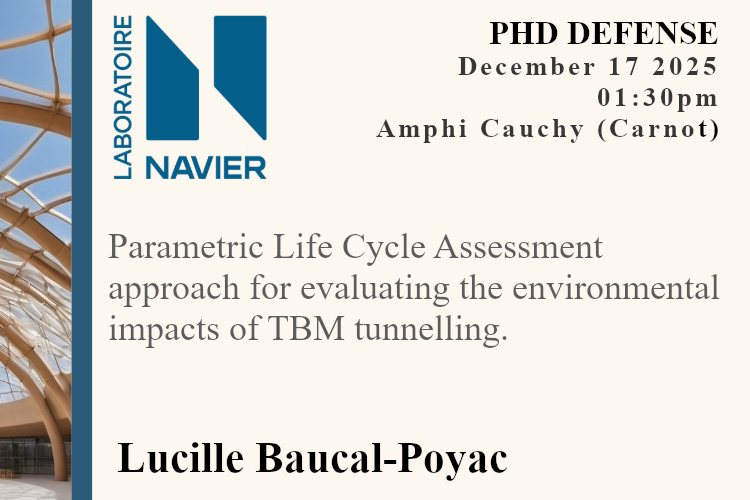
Lucille Baucal-Poyac, a PhD candidate in the Architectured Materials and Structures team will defend his dissertation titled « Parametric Life Cycle Assessment approach for evaluating the environmental impacts of TBM tunnelling », on Wednesday, december 17 at 01:30 pm in the Cauchy amphitheater. (ENPC).
Composition of the jury :
- Dominique Millet, Professor, Université de Toulon, Reviewer
- Ben Armor , Professor, Université de Sherbrooke, Reviewer
- Natasha Gondran, Professor, Mines de Saint-Etienne, Examinator
- Jean-Michel Torrenti, Researcher, Université Gustave Eiffel, Examinator
- Olivier Deck, Professor, Université de Lorraine, Examinator
- Myriam Saadé, Researcher, CNRS, Examinator
- Adelaïde Ferraille, Professor, Ecole Nationale des Ponts et Chaussées, Thesis Director
- Laetitia d’Aloia Schwartzentruber, Researcher, Centre d’Etudes des Tunnels, Thesis Supervisor
The defense will be broadcasted live on : Microsoft Teams
Abstract
Parametric Life Cycle Assessment approach for evaluating the environmental impacts of TBM tunnelling
Tunnels are playing an increasingly important role in infrastructure projects due to the benefits they offer in comparison to surface solutions. In dense urban areas, they free up space, reduce noise and visual pollution, and enhance the interconnection of transport networks, as demonstrated by the Grand Paris Express. In mountainous regions, they reduce gradients, shorten distances and facilitate modal shifts, as illustrated by the Mont-Cenis Base Tunnel project, a key component of the cross-border section of the Lyon-Turin railway line (TELT). Among the various tunnelling methods, Tunnel Boring Machines (TBMs) are the most effective for long structures thanks to their adaptability to diverse geotechnical and hydrogeological conditions and the safer working environment they provide.
However, tunnel construction has significant environmental impacts due to the large amounts of energy and materials required. While conventional excavation methods have already been assessed through carbon footprint and life cycle assessment (LCA) studies, TBM tunnelling has only been partially assessed, since the machine itself is not fully included within system boundaries. Moreover, as each project has its own design characteristics as well as geological and geographical context, the generalisation of existing results remains limited.
In this context, this thesis pursues two objectives : i) to develop a parametric LCA model covering the entire life cycle of a TBM, from manufacturing to end-of-life, including the operational phase; ii) to propose predictive models of environmental impacts based on key project characteristics. The TELT project served as the main case study.
An initial static LCA model was established. Two allocation methods were studied in order to quantify the environmental impacts and benefits associated with components reuse and material recycling, both at upstream and downstream levels of the life cycle. Uncertainty and sensitivity analyses were also performed on the input data.
From this, a parametric approach was developed using a database of more than 500 TBMs provided by the TBM manufacturer Herrenknecht. A model for estimating the electricity consumption of excavation and another for assessing the replacement rate of TBM disc cutters – both linked to the TBM control parameters and the geotechnical conditions – were integrated into the framework. Uncertainty and variability parameters were sampled using Sobol’ sequences, generating a numerical design of experiments to evaluate the environmental impacts of each tunnelling scenario. Sensitivity analysis with Sobol’s indices was then applied to rank the parameter influence on the variance of environmental indicators.
Identifying the most influential parameters enables the creation of a reduced dataset, which was used to develop predictive models of environmental impacts. Two regression models were explored : the multiple linear regression and the XGBoost algorithm. Their performance was evaluated using statistical indicators based on mean squared error and mean absolute percentage error.
Future work could extend the system boundaries to the full life cycle of the tunnels, integrate other TBM types (slurry, Earth Pressure Balance, etc.), and address uncertainties related to environmental databases. Two additional methodological directions are also emerging : i) coupling predictive models with multi-criteria optimisation approaches (e.g., climate change and abiotic resources depletion), and ii) integrating economic and social dimensions with the aim of sustainable development.
Keywords : Tunnel Boring Machine; Life Cycle Assessment (LCA); Underground structures; Parametric approach; Environmental impacts; Predictive model.