


Master internship – Strain Localization in Granular Materials: Experimental Investigation Using Triaxial Testing and X-Ray Microtomography
- Post by: Mathias Lebihain
- 16 March 2026
- No Comment
Context: Granular materials subjected to shear often undergo a transition from homogeneous deformation to localized deformation, leading to the formation of shear bands —narrow zones of intense strain that control material failure (Fig.1). Classical continuum models such as the Mohr–Coulomb and the Drucker–Prager failure criterion assume material homogeneity. However, this assumption breaks down once strain localization emerges, as particle rearrangements and fabric evolution introduce strong internal heterogeneities. Although enriched and two-scale models attempt to describe behavior inside and outside shear bands separately, the grain-scale mechanisms driving localization—particularly during triaxial compression and near the critical state—remain insufficiently understood. A better understanding of these processes is essential for improving constitutive models in geomechanics and for predicting geophysical hazards such as landslides and earthquakes.
Objectives: The primary objective of this project is to experimentally investigate how controlled grain-scale heterogeneities influence the onset and evolution of strain localization in granular materials subjected to triaxial compression.
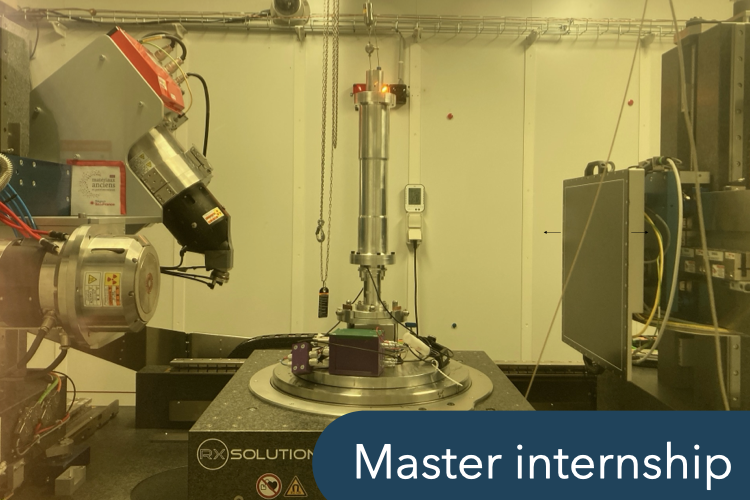
Methods: Mechanical tests will be conducted using a newly developed triaxial cell (Fig.2) designed within the CNRS Ingénierie INSTAGRATOM project in order to characterize the macroscopic response of granular assemblies under well-controlled loading conditions. Selected samples will then be analyzed using X-ray microtomography (XRCT) at the microtomography platform of Laboratoire Navier and complemented by additional measurements at the BM18 beamline of the European Synchrotron Radiation Facility, providing three-dimensional insight into the evolution of internal structure during deformation.
To systematically investigate the role of heterogeneity, samples will be prepared with different mean particle sizes, and larger inclusions—5 to 10 times the base grain diameter—will be randomly introduced at controlled volumetric fractions (5%, 10%, 20%, and 30%), with both stiffness-matched and stiffness-contrasted configurations. These inclusions are expected to act as perturbation sources that may trigger early micro-shear band formation. By combining mechanical measurements with microstructural characterization, the project seeks to establish quantitative relationships between grain-scale descriptors—such as fabric evolution, contact network organization, and porosity distribution—and the macroscopic stress–strain response. The experimental findings will be compared with ongoing discrete numerical simulations (DEM), thereby fostering strong experimental–numerical synergy and contributing to improved predictive modeling of strain localization in granular media.
Candidate profile: The internship is intended for Master’s students or final-year engineering students in mechanical engineering, civil engineering, physics, or materials science. Applicants should demonstrate a strong interest in experimental mechanics and granular materials. Experience in image processing or microstructural analysis would be advantageous but is not required. The project will particularly suit candidates motivated by multi-scale approaches and interested in gaining a deeper understanding of geophysical failure mechanisms.
Location: Champs-sur-Marne, Paris, France—30 minutes by train (RER A) from the city center.
Duration : 4 to 6 months, with a flexible starting date between March and May 2026.
Salary: Approximately €550 per month, in accordance with standard French internship regulations.
Research team: The internship will be carried out at Laboratoire Navier under the supervision of Patrick Aimedieu (Research Engineer), Michel Bornert (Researcher), and Kianoosh Taghizadeh (Researcher and coordinator of the CNRS Ingénierie INSTAGRATOM project).
Interested candidates are invited to contact Kianoosh Taghizadeh (kianoosh.taghizadeh@enpc.fr) or Michel Bornert (michel.bornert@enpc.fr).