


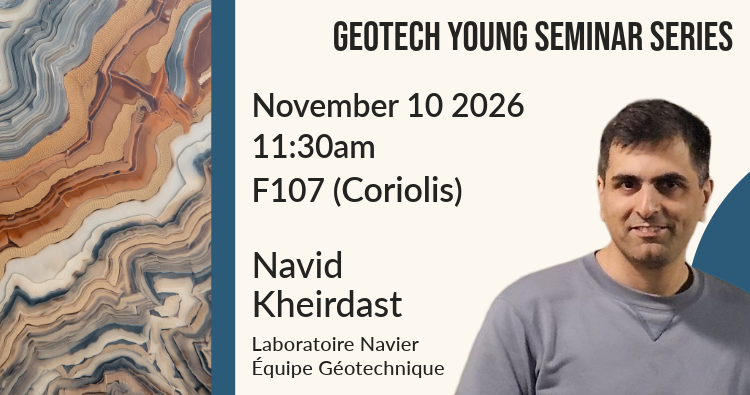
Geotech Young Seminar Series: Dr. Navid Kheirdast (Navier)
Earthquake Rupture: From Observation to Fault Mechanics
Abstract:
Earthquake rupture is among the most enigmatic natural phenomena, and its spontaneous nature raises several key questions: (1) how did rupture nucleate, accelerate, and expand during a given past event? (2) how often does a given fault host large earthquakes? and (3) how do long-term geodynamic processes affect a fault system, and which regions are most susceptible to future earthquakes given the far-field loading on the faults?
To invert seismic data for the spatio-temporal history of fault slip, we propose a mathematical technique, inspired by neural networks, that reduces the number of basis functions needed to expand the slip rate. We solve the problem in the frequency domain and, after presenting a synthetic test, demonstrate its capability by recovering the rupture histories of the 2016 M6.2 Amatrice (Italy) and 2019 M7.1 Ridgecrest (California) earthquakes.
While an accurate image of the coseismic rupture is essential for inferring fault properties, it is only a snapshot of a much longer tectonic process. The forces that drive earthquake rupture evolve over long time periods and across regions much larger than the fault plane itself. In the second part of the talk, I present earthquake statistics and show how incorporating damage in the fault zone allows us to reproduce the seismicity rates observed in earthquake catalogues.
The nature of the loads acting on faults remains poorly understood; however, the background stresses that faults inherit are closely linked to fault geometry within a given tectonic setting. In the final part of the talk, I present earthquake models informed by geodynamic processes and show how these coupled models help identify the most hazardous regions on faults.
Short bio:
I studied civil engineering as an undergraduate, structural engineering for my master’s degree, and seismology for my PhD. As a postdoctoral researcher, I have worked on seismic-cycle simulations, on the effect of the damage zone on earthquake size and frequency, and on the energy dissipated by damage and fracture. I am interested in understanding earthquake physics, in particular the nature of the forces that drive and resist earthquake rupture.