


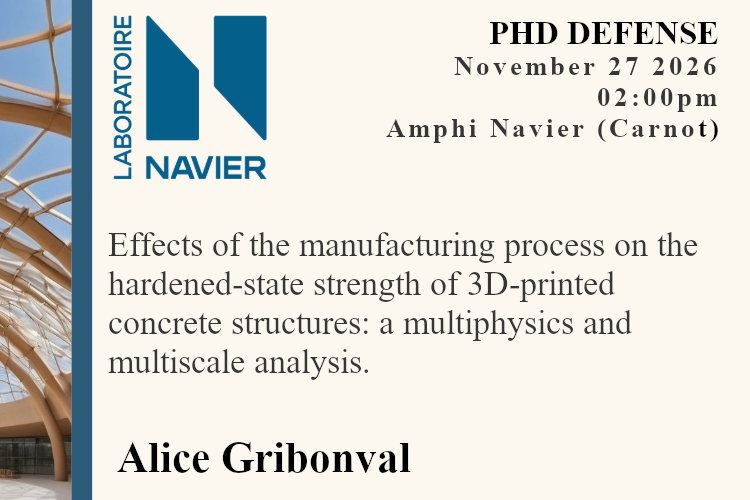
Thesis Defense – Alice Gribonval
- Post by: sebastien.gervillers
- 20 November 2026
- No Comment
Alice Gribonval, PhD student in the Architectural Materials and Structures team at the Navier laboratory, will defend their thesis entitled “Effects of the manufacturing process on the hardened-state strength of 3D-printed concrete structures: a multiphysics and multiscale analysis" on Friday, November 27, 2026 at 2:00 PM, at Amphi Navier.
The defense will be held in english.
The defense will be broadcast at the following link: https://teams.microsoft.com/meet/3695518927854540?p=sh3Q8VXm0eaCWJmNTg
Thesis Jury
The thesis jury is composed of the following members:
- Sébastien Rémond, Université d’Orléans, Reviewer
- Rob Wolfs, Eindhoven University of Technology, Reviewer
- Christelle Combescure, Académie militaire de Saint-Cyr Coëtquidan, Examiner
- Fabrice Gatuingt, ENS Paris-Saclay, Examiner
- François Toutlemonde, Université Gustave Eiffel, Examiner
- Luca Sorelli, Université Laval, Examiner
- Jérémy Bleyer, Navier, Director
- Nicolas Ducoulombier, XtreeE, Co-supervisor
- Romain Mesnil, Navier, Invited
- Karam Sab, Navier, Invited
- Dominique Corvez, XtreeE, Invited
Abstract
This doctoral research aims to develop mechanical modelling methods for 3D-printed concrete structures to better understand the specificities of the printing process and quantify their impact on structural behaviour.
In the absence of formwork, printed structures are highly exposed to the ambient environment. Due to their high surface-to-volume ratio, water loss due to evaporation after deposition is significant. An experimental campaign conducted as part of this thesis quantifies the effects of evaporation on the compressive strength of printed specimens. Subsequently, a thermo-poro-mechanical model is calibrated, accounting for the evolution of mechanical properties associated with cement hydration. This model is used to quantify the effects of evaporation on the mechanical properties and plastic shrinkage of printed walls, as well as to evaluate the effectiveness of various preventive measures.
Secondly, a multi-scale model is developed to account for the effects of layer geometry and deposition strategies on the behaviour of hardened printed structures, using a plate model accessible for practical engineering applications. First, the elastic behaviour is estimated via periodic homogenisation, allowing for the quantification of anisotropy induced by the layer geometry. Based on the 3D stress distribution recovered from the homogenisation results, a failure probability is then estimated using a two-scale Weibull model.
Finally, the practical applicability of the proposed model is illustrated through several applications, representative of current 3D concrete printing use cases.