


Stage M2/PFE – Efficient multiscale modeling for predicting the mechanical responses of short-fiber composite materials
- Post by: sebastien.gervillers
- 25 November 2026
- No Comment
Background and motivation :
The multiscale modeling of heterogeneous materials is a central challenge in computational mechanics, as their macroscopic mechanical response is closely related to the underlying microstructural morphology, which might induce strong local field heterogeneity. Short-fiber-reinforced composites (SFRCs) (see below right) provide a representative example of such materials, exhibiting complex microstructures characterized by heterogeneous fiber orientations, spatial distributions, and local anisotropy. Accurately capturing these microstructural features and their influence on effective material behavior is essential for developing reliable microstructure-informed constitutive models, to be further integrated into design and reliability assessment of industrial parts (see below left).
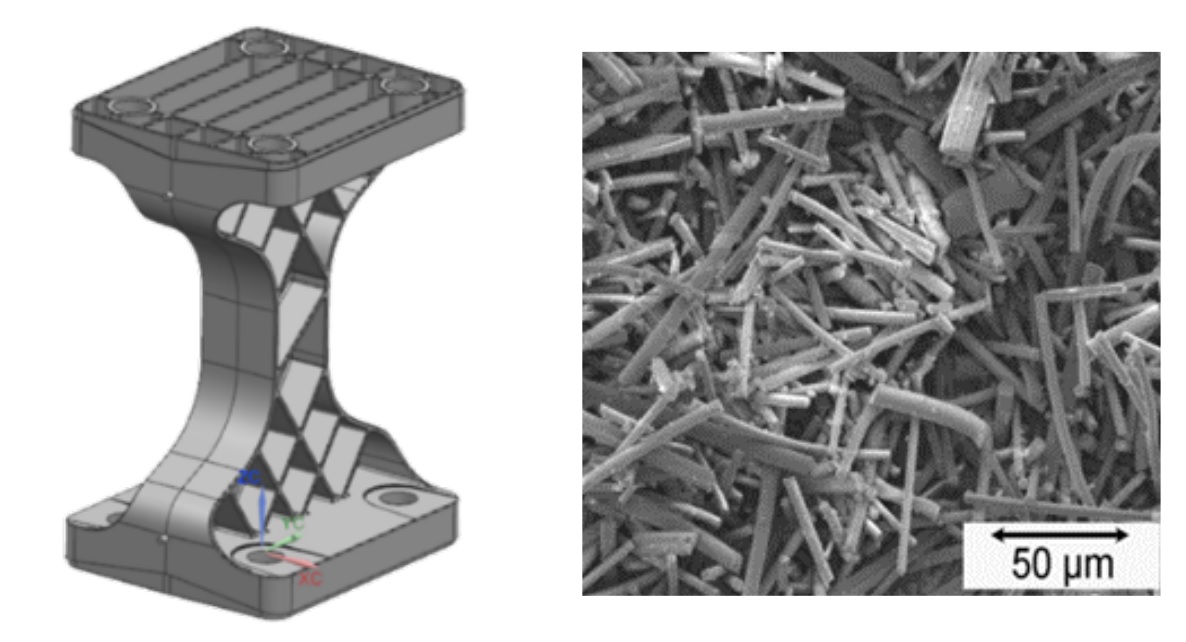
Industrial demonstrator studied in the AnoHonA project, supplied by Domo Chemicals (120 × 140 × 210 mm, left), and SEM image of the composite microstructure (right).
Objective :
The objective of this internship is to develop an efficient microstructure-informed computational framework for the multiscale modeling of short-fiber-reinforced composites. The work will focus on generating representative microstructures with realistic fiber distributions and orientations, investigating self-consistent clustering analysis (SCA) as a reduced-order homogenization approach, and evaluating its ability to capture microstructural interactions and predict effective mechanical properties. Finally, the developed reduced order micromechaical modeling will be incorporated into the concurrent multiscale simulation framework by using commercial finite element analysis (FEA) software, e.g. ABAQUS.
Candidate profile :
- First/second-year master or second/third-year engineering school student (or equivalent) in mechanics, civil engineering or applied mathematics.
- Strong interest in micromechanics, computational solid mechanics and multiscale modeling.
- Desirable skills: programming (e.g., Python, JAX, C++).
Further informations and applications :
Duration: 5–6 months, starting in spring 2027.
Location: Laboratoire Navier, CNRS UMR 8205, University Gustave Eiffel, École nationale des ponts et chaussées, Institut Polytechnique de Paris, Marne-la-Vallée, 77420, France
Advisors: Tong-Rui Liu, Michel Bornert, Jérémy Bleyer, Frédéric Legoll.
Please send your up-to-date CV and motivation letter to:
tongrui.liu@enpc.fr, michel.bornert@enpc.fr, jeremy.bleyer@enpc.fr, frederic.legoll@enpc.fr